


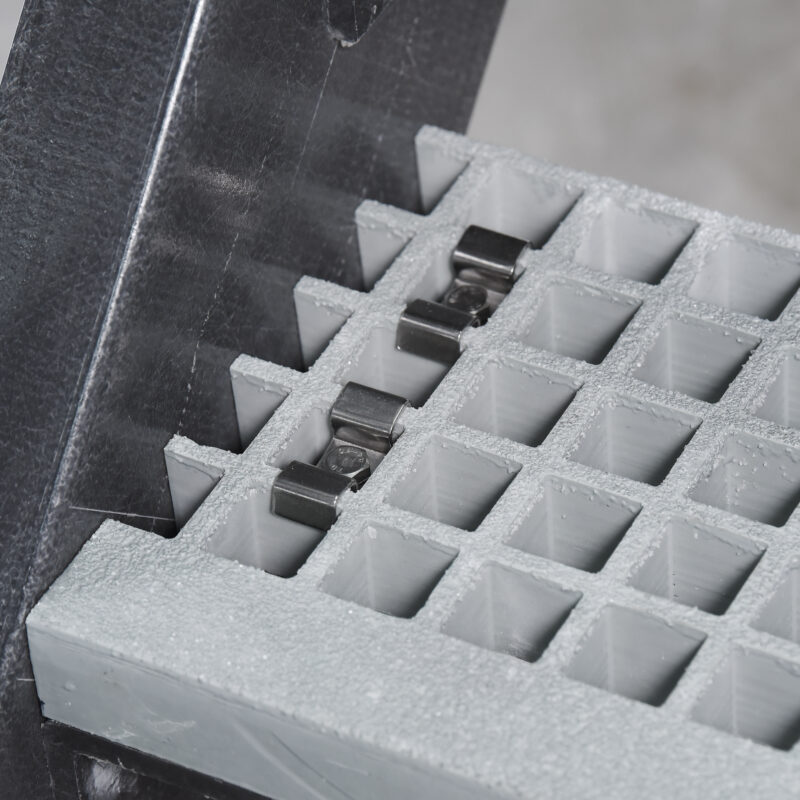


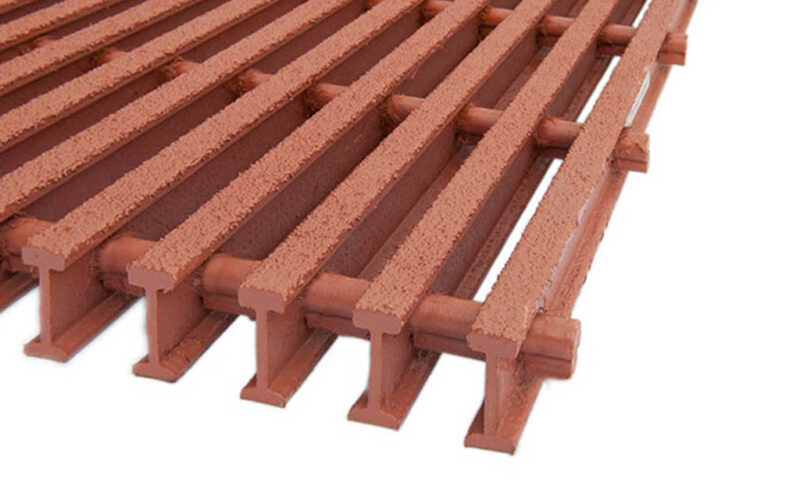

Plastic grid
R4-6015P – Pultruded Grille
This phenolic resin GRP grating is suitable for various applications and is available in multiple sizes. This type is particularly suitable for environments where increased fire safety is required and features a quartz grit anti-slip top layer.
- Heights
- 38mm
- Resin types
- Phenolic
- Toplayer
- Quartz Grit
- Colors
- Red
- Weight types
- 13,8 kg/m²
| Article number | Height | Length | Width | Quotation |
|---|---|---|---|---|
| R4-6010-6015P | 38 | 6000 | 1000 | Request a quotation |
| R4-CTS-6015P | 38 | CUST | CUST | Request a quotation |
Frequently asked questions about this plastic grid
-
The term ‘fire retardant’ literally means ‘flame retardant’.
A fire retardant GRP grating is treated or composed with fire retardant additives in the resin, making the material difficult to ignite and, when exposed to fire, slower to ignite and producing less smoke than standard plastic.
At FlexxCon, we use an isophthalic polyester resin with fire retardant properties (ISOFR) as standard.
This type of resin complies with various fire and smoke standards, depending on the application and certification.How does ‘fire retardant’ work in GRP?
- The resin contains flame retardant substances (often halogen-free) that slow down combustion.
- When the material is exposed to fire, a carbon layer (char) forms on the surface, limiting the oxygen supply.
- This slows down the spread of fire and keeps the structure intact for longer.
- Smoke development and heat release are lower than with untreated plastics.
Fire safety of GRP gratings
The fire reaction of GRP depends on the resin used:
Resin type Fire reaction/properties Application ISOFR (Isophthalic polyester fire retardant) Flame retardant, limited smoke formation, complies with many industrial standards. Standard at FlexxCon, suitable for most applications. Vinyl ester (VE) Flame retardant, with higher thermal stability. Recommended for higher temperatures or chemical exposure. Phenolic (PH) Very high fire resistance, low smoke and toxic gas emission, complies with IMO and EN 45545. For offshore, tunnels, transport and fire-critical installations. What does this mean in practice?
- GRP gratings do not burn spontaneously; they require an external ignition source.
- When the source is removed, the material extinguishes itself (self-extinguishing).
Please note:
- “Fire retardant” means flame retardant, not “fireproof”.
The grating slows down the spread of flames, but does not form a fireproof barrier. - For projects with specific fire standards (such as EN 13501, ASTM E84 or IMO FTP), always consult the appropriate certificates or let us help you with your choice of material.
👉 Want to be sure which type of GRP grating meets the fire standards for your project? Contact us for technical advice or certification information.
-
At FlexxCon, we supply our GRP gratings with an isophthalic polyester fire retardant resin (ISOFR) as standard. This resin offers an excellent balance between mechanical strength, chemical resistance and fire retardant properties. Ideal for industrial applications.
We also supply vinyl ester (VE) and phenolic (PH) gratings as options, depending on the requirements of your project.
Resin type Designation Key properties Typical applications Isophthalic polyester (fire retardant) ISOFR Our standard resin with high chemical resistance, high strength and fire-retardant properties. Industrial environments, work floors, landings and platforms. Suitable for most general applications. Vinyl ester VE Very high chemical resistance, resistant to acids, alkalis and solvents. Also higher temperature resistance than ISOFR. Chemical industry, water treatment, maritime sector and environments with aggressive media. Phenolic PH Excellent fire resistance and low smoke emission. Resistant to high temperatures and complies with strict fire standards. Offshore, shipping, oil and gas industry, tunnels and transport applications. Orthophthalic polyester OP Basic type polyester resin with limited chemical and fire performance. Not suitable for heavy industrial or fire-sensitive applications. Not available as standard from FlexxCon. Why do we choose ISOFR as standard?
Many suppliers use orthophthalic polyester as their standard resin, but this often does not meet the requirements of industrial applications.
At FlexxCon, we therefore supply ISOFR gratings as standard, so you can be sure of a high-quality, high-performance grating.For projects with specific requirements, such as high chemical exposure, ATEX environments or strict fire standards, we recommend choosing vinyl ester or phenolic resin. We would be happy to advise you personally on this!
👉 Not sure which resin is best suited to your application? We are happy to help you choose the right material based on the environment, load and safety standards.
-
We often process requests on the same day or by the next working day at the latest.
We aim to provide standard GRP gratings and customised GRP gratings in small quantities (e.g. for a platform) within 1–2 working days.
For grating requests, a grating drawing (or simple sketch) helps us to provide a faster and more targeted quote.For project requests, we aim to provide a quote within one week. A grating layout, sketch or preliminary design significantly speeds up this process.
In addition, we sometimes need additional information, such as:- when you need the grating
- whether the dimensions and layout have already been determined
- and what the basic principles are (grating type, load, span protrusions)
Once these basic principles are clear, we can usually respond quickly.
GRP structures (such as platforms, ladders and handrails) usually require more coordination.
Once the basic principles are known (preferably supported by a sketch or design), we can often provide a quote within a week.If we still need to work out some details together, we will actively contact you and let you know when you can expect the quote.
-
Traditional steel or stainless steel gratings consist of bearing bars and filler bars. The bearing bars determine the bearing direction: the grating bears in one main direction. Often referred to as:

With GRP gratings, this works differently, depending on the type of grating:
Moulded GRP gratings (the standard at FlexxCon): Our moulded GRP gratings are cast in one piece from fibreglass and resin. There are no separate bearing or filler bars; the grating forms a single cohesive structure in which all bars contribute to the strength.
This means:
- The grating bears load in four directions.
- There is no fixed bearing direction as with steel or stainless steel.
- With four-sided support, the shortest span can generally be used as the design span.
This multi-directional load-bearing capacity makes moulded GRP gratings strong, stable and flexible in application, even in complex support situations.
Pultruded GRP gratings (specific applications): In pultruded GRP gratings, the structure is made up of load-bearing and filler bars.
These behave in a similar way to steel gratings:- The load-bearing direction is parallel to the load-bearing bars.
- The strength is mainly directional, transferring to two sides.
- They are used where long spans or high stiffness in one direction are required.
👉 When designing or replacing gratings, it is important to know what type you have and how it is supported. We are happy to advise you on the right choice of grating, support and span.
-
Standard sizes (stock)
These are the panels we have in stock. The range of available panel sizes may vary depending on the type of grating. The availability of standard panels can be found under the relevant grating type on our website.
In addition to our standard commercial sizes, we can supply gratings that are made to measure for your specific application. We offer various options for customised GRP gratings, depending on your requirements, schedule and project size. There are various possibilities, but two are most common:
CTS (Cut to Size) – cut from stock panels
These GRP gratings are cut to size from our existing stock. We charge cutting costs and there is some material loss. We can easily calculate this.- Advantages: Fast delivery time, depending on the availability of the material (common grid types are usually in stock) and the current sawing schedule. Ideal for standard projects, smaller quantities or urgent projects.
CUST (Custom) – project-based production
These gratings are produced entirely to measure, with no or minimal material loss and often without or at lower processing costs.- Advantage: Cost-efficient for larger projects or repetitive dimensions.
- Disadvantage: Longer delivery time. In recent years, FlexxCon has built up such a strong position that there is always material in production, which means we can often switch quickly to ensure the shortest possible lead time. This is always custom work, and we are happy to help you personally.
In summary:
- CTS = fast delivery, ideal for standard and smaller or urgent orders.
- CUST = more efficient for larger quantities or fixed dimensions, but longer delivery time.