


Frequently Asked Questions
Do you have questions about our products, materials, or delivery? On this page, you’ll find the most frequently asked questions clearly organized by category. This way, you immediately know what to expect and can quickly find the right information.
Filter
- General information
- Inquiries, quotations, orders and cooperation
- Processing and installation
- Design and engineering
- Warranty, service life and maintenance
- Delivery, transport and logistics
- Standards and certification
- Product information GRP constructions
- Product information GRP gratings
- Technical specifications
General information
-
We are frequently asked this question in relation to offshore and maritime projects. The short answer is: yes, GRP gratings may be used on escape routes, but not in all locations. Permissibility depends on the location and is determined by the classification of the area according to the requirements of classification bodies such as DNV.
What is the basis for the assessment?
In practice, the discussion regarding the use of GRP gratings on escape routes almost always focuses on fire behaviour and smoke development. It is not so much about slip resistance or structural strength.
DNV Areas and Fire Integrity Levels
DNV classification uses so-called Areas, linked to Structural Fire Integrity Levels (such as L0, L1 and L2).
These determine which materials are permitted in specific locations, including escape routes.In general:
L1 areas (e.g. critical escape routes and fire-fighting access)
- No certified and permitted GRP gratings are available for these locations.
- In practice, steel is almost always used in these zones.
L0 and L2 areas (such as open decks, secondary escape routes and certain walkways)
- Suitable and certified GRP gratings are available for these locations, depending on the grating type and the resin system used.
Examples:
- ISOFR moulded GRP gratings → available with fire class L0
- Phenolic pultruded GRP gratings → available with fire class L2
DNV certification and substantiation
Both ISOFR moulded and phenolic pultruded GRP gratings are available with DNV certification. DNV uses tables (Type Approval matrix) for this purpose, which specify for each Area:
- which Fire Integrity Level is required,
- and which materials are permitted there.
In practice, these tables are often decisive during inspections.
👉 We provide this DNV table / Type Approval matrix as supporting documentation, so that it is clear and demonstrable to the inspector and end customer.
In summary
- GRP gratings may be used on escape routes, but not in all locations
- Permissibility depends on the location and area
- L1 areas → no suitable GRP gratings available
- L0 and L2 areas → suitable and certified GRP gratings available
- Acceptance is substantiated with DNV Type Approval tables
👉 We are happy to assist you in selecting the right grating type and certification for your offshore or maritime application.
-
The term ‘food grade’ is often used in practice, but there is no clearly defined standard for (GRP) gratings or structural products.
GRP gratings are not intended for direct contact with food, but can be used in food and processing environments, provided they are correctly specified and used.
How is GRP used in food environments?
In food processing environments, GRP gratings are often used as:
- walkways and platforms,
- work platforms,
- inspection and maintenance floors.
Important properties in this regard are:
- corrosion resistance,
- ease of cleaning,
- anti-slip, even in wet conditions,
- and resistance to cleaning agents.
What is important to know?
- GRP gratings are not food contact materials.
- There is no general ‘food grade certification’ for grates.
- Suitability depends on:
- the resin used,
- the surface finish,
- the cleaning methods,
- and the specific requirements of the environment (e.g. HACCP).
Therefore, each application is assessed to determine whether a GRP grating is suitable for the food or process environment in question.
Tailored to each project
For applications in food or hygienic environments, it is important to:
- discuss the environment and cleaning,
- determine whether direct or indirect contact is possible,
- and take any project- or customer-specific requirements into account.
👉 Do you have any questions about the use of GRP gratings in a food or process environment? Please feel free to contact us — we will be happy to assess each situation individually.
-
GRP gratings are regularly used in food and process environments, but it is important to distinguish between indirect applications and direct food contact. The term ‘food grade’ is often used in practice, but it is not a fixed standard for GRP gratings or other construction products.
✅ Applications for which GRP gratings are suitable
GRP gratings are suitable for use in food environments where they do not come into direct contact with food, for example:
- walkways and platforms in production and processing areas
- working and inspection platforms around installations
- floors in wet or corrosive environments
- areas that are regularly cleaned with water or cleaning agents
Important properties in this regard are:
- corrosion resistance
- ease of cleaning
- non-slip, even in wet conditions
- resistance to commonly used cleaning agents
❌ Applications for which GRP gratings are not intended
GRP gratings are not suitable for applications involving direct food contact, such as:
- cutting, preparation or processing surfaces
- Near, above or on transport or support of unpackaged food
- applications where materials must explicitly comply with food contact material regulations
GRP gratings are structural products and not food contact materials.
Applications requiring assessment
There are situations in which suitability must be assessed on a project-by-project basis, for example:
- areas with increased hygiene requirements
- use of aggressive or specific cleaning agents
- customer-specific or audit-specific requirements
- combination of moisture, temperature and chemical exposure
In these cases, factors such as the type of resin, surface finish and cleaning method play a role.
Important to know
- There is no general “food grade certification”.
- Suitability depends on the application and environment, not just the material
- Assessment takes place at situation and project level
In summary
- GRP gratings are suitable for indirect applications in food environments
- They are not intended for direct food contact
- Coordination is necessary in hygienically critical areas
👉 Are you unsure whether GRP gratings are suitable for a specific food application? Feel free to contact us — we are happy to help.
-
To provide a clear overview of the various installation methods, we have a detailed leaflet available that explains all the options. This leaflet makes it easy to determine which method best suits your situation.
Once you have found the right installation method, you can then filter the fastening materials category based on your grille specifications. This allows you to quickly and easily find the right set or part for your application.
👉 We are happy to advise you on the most suitable fastening method and can also supply the right fasteners.
-
FlexxCon specialises in glass fibre reinforced plastic (GRP) products. We supply a complete range, varying from gratings, profiles and steps to complete constructions and customised solutions. In addition to delivery from stock, we also provide support with engineering, design and assembly, so that you can always count on a sustainable and safe customised solution.
Inquiries, quotations, orders and cooperation
-
We often process requests on the same day or by the next working day at the latest.
We aim to provide standard GRP gratings and customised GRP gratings in small quantities (e.g. for a platform) within 1–2 working days.
For grating requests, a grating drawing (or simple sketch) helps us to provide a faster and more targeted quote.For project requests, we aim to provide a quote within one week. A grating layout, sketch or preliminary design significantly speeds up this process.
In addition, we sometimes need additional information, such as:- when you need the grating
- whether the dimensions and layout have already been determined
- and what the basic principles are (grating type, load, span protrusions)
Once these basic principles are clear, we can usually respond quickly.
GRP structures (such as platforms, ladders and handrails) usually require more coordination.
Once the basic principles are known (preferably supported by a sketch or design), we can often provide a quote within a week.If we still need to work out some details together, we will actively contact you and let you know when you can expect the quote.
Processing and installation
-
GRP gratings can be cut to size yourself. In practice, this is often done during on-site installation, for example to make gratings fit or to provide recesses.
The following guidelines apply to cutting:
- Small cut-outs or notches can be made easily with a jigsaw.
- For longer, straight cuts, a circular saw is the most efficient tool and gives the cleanest result.
Saw blades
Special saw blades for GRP are available for both machines. These are often referred to as glass fibre, GRP or composite saw blades by tool suppliers.Please ensure that you use the correct personal protective equipment when working with GRP.
Accessories and finishing
We can also supply you with the right sawing accessories for cutting GRP gratings. We also offer finishing sets to neatly finish the saw cuts. -
We recommend always treating cut edges. We finish the cut edges as standard and also seal them, so that the product is suitable for all applications. Finishing cut edges consists of two steps, each of which has its own function.
1. Remove protruding fibres (always do this)
After cutting, protruding glass fibres may be present on the cut edge. These can cause skin irritation, sharp edges or an unfinished appearance. We always remove protruding fibres, regardless of the application. We do this with an angle grinder fitted with a sanding disc.Practical guideline:
- Use a sanding disc or flap disc
- Grit size: approximately K60 – K80 (coarse enough to remove fibres without unnecessarily damaging the material)
👉 The aim is not to remove material, but to make the edge fibre-free and safe.
2. Sealing the cut edge (We always do this)
After removing the fibres, the cut edge can be sealed with resin or coating. Sealing is particularly recommended when:
- the cut edge remains visible or accessible,
- regular hand contact is possible,
- the grille is used in an aggressive or humid environment,
- or when a smooth, durable finish is desired.
What if you cut the grating yourself?
You can decide for yourself whether to remove the fibres and seal the cut edges.
We recommend following these steps, as this results in a safer, neater and more durable finish in practice.
The final choice depends on the application, accessibility of the cut edge and the environment in which the grating will be used.We can supply sealing kits to neatly seal cut edges.
👉 Not sure about the right finish for your application? Feel free to contact us, we will be happy to advise you.
-
In GRP gratings, open and closed meshes refer to the finish of the outer edge of the grating.
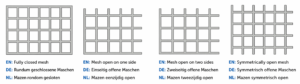
A GRP grating consists of a fixed mesh pattern, for example meshes with a centre-to-centre distance of 38.1 mm and a bearing bar thickness of 7 mm.
Depending on where the grating is cut, the outer edge can:
- end on a bearing bar, which we call a closed mesh (the edge is closed), or
- end in the middle of a mesh, which we call an open mesh (the edge has an opening).
An open mesh is not a problem in terms of construction: the strength and load-bearing capacity remain the same. However, this may be undesirable from an aesthetic or safety point of view, for example at the outer edge of a platform or staircase. In such cases, the open side is often placed against a closed side of an adjacent grating, so that no open edge is visible or accessible.
When cutting GRP gratings to size, we cannot cut through a bearing bar. That is why we always cut between the bearing bars (in the mesh). If your dimensions are such that the cut falls within a bearing bar, the dimensions can be slightly rounded off to the nearest cutting point in the mesh pattern. This does not affect the quality, but it can determine whether a grating ends with an open or closed mesh.
Design tip: During the design phase, it is advisable to adjust the dimensions to a closed mesh. This ensures a neat edge finish and prevents open meshes on visible or walkable edges. We have tables available to determine the optimal grating dimensions, which can be downloaded here.
-
When working with GRP (such as sawing), dust and fibre particles are released. It is therefore important to use the correct personal protective equipment (PPE).
We recommend the following:
- Wear long-sleeved work clothes and gloves (to prevent skin irritation from small particles).
- Safety goggles (protect the eyes against dust, splinters and flying fibres)
- Safety footwear (for general protection during installation and handling of gratings)
- Hearing protection (earplugs or earmuffs)
- Respiratory protection; for example, a dust mask with a suitable filter class to prevent inhalation of GRP dust.
- Dust extraction; Preferably use tools with local dust extraction to minimise dust formation.
Why is this important?
GRP is safe to work with, but fibreglass dust is irritating to the skin, eyes and respiratory tract. With the right PPE and dust extraction, the work remains safe, comfortable and responsible.👉 Are you unsure about the right PPE or would you like advice for your specific situation? Please feel free to contact us.

Design and engineering
-
We design GRP structures ourselves, but can also work based on your design. A design or sketch you provide can serve as an excellent basis for a quotation. When a project is further developed towards production, we usually create our own design.
We do this for several reasons:
- to ensure a good fit with adjacent structures and situations
- to establish structural principles
- to draw up the component and assembly drawings required for our production
Drawings and file formats
We draw in Tekla and AutoCAD, among other programmes, and can work with various file formats. This allows us to easily connect to the existing design, drawing or BIM model.Do you already have drawings available? Then we will gladly use them as a starting point. If things still need to be worked out or optimised, we will take care of that in consultation with you.
👉 Whether you already have a complete design or are still in the design phase: we are happy to contribute our ideas and ensure a manufacturable, well-fitting GRP construction.
-
Standard sizes (stock)
These are the panels we have in stock. The range of available panel sizes may vary depending on the type of grating. The availability of standard panels can be found under the relevant grating type on our website.
In addition to our standard commercial sizes, we can supply gratings that are made to measure for your specific application. We offer various options for customised GRP gratings, depending on your requirements, schedule and project size. There are various possibilities, but two are most common:
CTS (Cut to Size) – cut from stock panels
These GRP gratings are cut to size from our existing stock. We charge cutting costs and there is some material loss. We can easily calculate this.- Advantages: Fast delivery time, depending on the availability of the material (common grid types are usually in stock) and the current sawing schedule. Ideal for standard projects, smaller quantities or urgent projects.
CUST (Custom) – project-based production
These gratings are produced entirely to measure, with no or minimal material loss and often without or at lower processing costs.- Advantage: Cost-efficient for larger projects or repetitive dimensions.
- Disadvantage: Longer delivery time. In recent years, FlexxCon has built up such a strong position that there is always material in production, which means we can often switch quickly to ensure the shortest possible lead time. This is always custom work, and we are happy to help you personally.
In summary:
- CTS = fast delivery, ideal for standard and smaller or urgent orders.
- CUST = more efficient for larger quantities or fixed dimensions, but longer delivery time.
Warranty, service life and maintenance
-
GRP (glass fibre reinforced plastic) contains no metal and no organic material such as wood. This makes the material resistant to rust, rot and classic corrosion, even when exposed to moisture or outdoor conditions for long periods of time.
So what can happen?
Although GRP does not rust or rot, the material can be damaged if used incorrectly. This usually has to do with the choice of resin in relation to the environment.For example, using an unsuitable resin in a highly chemically stressed environment can cause the following phenomena:
- Chemical degradation of the resin,
- softening or discolouration of the surface,
- and in extreme cases, delamination (the separation of layers within the material).
These are not forms of rust or rot, but the result of a chemical incompatibility between the medium and the resin.
Important to know
- The glass fibres themselves remain strong; the damage is in the resin matrix.
- This type of damage does not usually occur suddenly, but gradually with prolonged exposure.
- With the right choice of resin (e.g. ISOFR, Vinylester or Phenolic), this can be easily prevented.
That is why we always recommend taking the application into account when choosing materials for chemical, industrial or ATEX environments.
👉 In summary:
GRP does not rust or rot, but it must be specified correctly. With the right resin, GRP is an extremely durable solution, even in harsh industrial environments. -
By low maintenance, we mean that GRP products require virtually no active maintenance during their lifetime to remain safe and functional.
Unlike steel or wood:
- GRP structures do not rust,
- they are not susceptible to corrosion,
- and they do not need to be painted or coated to protect them.
This does not mean that nothing ever needs to be done, but it does mean that maintenance is limited to inspection and cleaning.
Maintenance for GRP usually consists of:
- periodic visual inspection,
- cleaning when dirty (e.g. dust, mud or product residues),
- checking for mechanical damage caused by external use.
There are no recurring tasks such as:
- sanding,
- preservation,
- repainting,
- or rust treatment.
Why is GRP low-maintenance?
GRP (glass-reinforced plastic) is naturally:- corrosion-resistant,
- chemically resistant,
- and resistant to weather and UV influences.
As a result, the material retains its properties, even in aggressive industrial or outdoor environments.
👉 Low maintenance therefore means: less downtime, lower maintenance costs and no surprises in the long term.
-
The lifespan of GRP depends on the application, environment and correct choice of material. Based on our experience, we estimate a lifespan of approximately 30 years for normal atmospheric conditions in Western Europe.
This does not mean that the material is ‘worn out’ after that. With correct application and favourable conditions, GRP can last longer in practice.
What determines whether GRP lasts longer?
Whether the lifespan exceeds the specified 30 years depends mainly on:
• the type of resin chosen (e.g. ISOFR, vinyl ester or phenolic),
• the degree of chemical or UV exposure,
• the mechanical load and deflection,
• and the quality of design, installation and use.When these factors are favourable, we see that GRP gratings and structures remain functional and safe after the specified service life.
When can the service life be shorter?
A shorter service life is usually caused by:
• the use of an unsuitable resin in an aggressive environment,
• prolonged exposure to media for which the material is not intended,
• or structural overload.
This can lead to surface ageing or, in rare cases, delamination, but not to rust or rot.Summary
Specified lifespan (Western Europe): approx. 30 years
Actual lifespan: longer, depending on application and environment👉 Would you like insight into the expected lifespan for a specific situation? We are happy to help you.
-
We apply a standard warranty period of two years. This warranty is based on the legal provisions under Dutch law and applies when used in accordance with the agreed specifications and principles.
In some cases, an extended warranty period is possible.
This is always a commercial and technical consideration, in which the following factors play a role:- the application and load,
- the environment (e.g. industrial or chemical),
- the chosen materials and resin types,
- the project size,
- and the agreed price.
An extended warranty period requires additional safeguards in terms of design, choice of materials and execution. This also means that an extended period cannot be combined with a rock-bottom price. If different agreements are made, these are always explicitly recorded in writing, for example in the quotation or agreement.
👉 Do you have any wishes regarding warranty or life expectancy? Feel free to discuss this in advance, so that we can carefully and realistically include this in our quotation.
Delivery, transport and logistics
-
As standard, we do not unload the pallets ourselves.
The lorry combinations we use for deliveries are equipped with tarpaulins (tautliners). This means that you must unload the pallets yourself using your own equipment, such as a forklift or telehandler.
Do you not have unloading equipment?
Then we can take care of this for you. In that case, a transport combination equipped with self-unloading equipment (e.g. a forklift) will be used.👉 Feel free to enquire about the options and any additional costs.
-
🚚📦 Yes, we also deliver.
Unless otherwise agreed in advance, we work on the basis of a quotation with a total price, which also includes transport costs.
You can easily check this on your quotation:
- Free delivery → delivery is included in the price.
- Ex Works (ex factory) → the price does not include transport; you are responsible for arranging transport yourself or this can be agreed in consultation.
Do you have specific requirements for delivery or call-off? Please feel free to contact us; we will be happy to help you find the most efficient transport solution.
-
Standard GRP gratings from stock can be shipped immediately and are often delivered within 1–2 working days.
Customised GRP gratings are cut from stock panels. The exact delivery time depends on the desired dimensions and the current cutting schedule.
It is best to discuss the shortest lead time with you personally.Due to their complexity, GRP structures (such as stairs, landings and platforms) usually have a longer lead time.
However, we are flexible in planning and production and can, where possible, step up to speed up projects.👉 Feel free to contact us for the current delivery time or a quick quote.
-
The edges of GRP gratings with square meshes are naturally vulnerable. During handling, transport or unloading, a slight impact may cause a small piece of the edge to break off. This is a known and typical characteristic of this type of grating.
Important to know:
- This edge damage is cosmetic in nature.
- The structural strength and safety of the grating remain unchanged.
- The grating still meets the specified technical requirements.
We understand that upon receipt, this may feel like a ‘damaged’ product, while in practice it does not pose any functional or structural problems.
Design tip: In applications where the edge remains visible or accessible, a closed edge, edge finish or connection to another grating can solve many of these visual effects.
This can easily be taken into account during the design or installation phase.
👉 If you have any questions about the edge finish, we are happy to help!
-
We deliver our materials on wooden pallets. The pallet size is tailored to the dimensions and weight of the shipment to ensure safe and efficient transport.
These are single-use pallets (also known as non-returnable pallets). They are not deposit pallets and become your property after delivery. You can reuse them or dispose of them as regular wood waste.
Standards and certification
-
NEN-EN-ISO 14122 is an internationally established ISO standard, which has been adopted within Europe as an EN standard and is published in the Netherlands as NEN-EN-ISO 14122. The standard sets requirements for permanent access to machines and installations, with the aim of ensuring safe access, operation and maintenance.
This standard covers walkways and platforms, among other things, with GRP gratings frequently being used as floor surfaces.
What does this standard say about GRP gratings?
NEN-EN-ISO 14122 provides guidelines for the properties of walking surfaces, such as:
- safe walking surface,
- anti-slip provisions,
- openings and mesh sizes (foot safety),
- and structural safety within the overall access situation.
GRP gratings, if correctly selected and applied, can fit well within the principles of this standard.
Not only the grating itself is decisive, but especially its application within the complete construction.Important to know
- NEN-EN-ISO 14122 is a design and application standard, not a product certificate.
- Whether a GRP grating can be used within this standard depends on:
- grating type and mesh structure,
- anti-slip design,
- load and span,
- and the method of installation.
👉 We are happy to advise you on choosing a GRP grating that complies with the principles of NEN-EN-ISO 14122.
-
NEN-EN-ISO 14122 is an internationally established ISO standard, which has been adopted within Europe as an EN standard and is published in the Netherlands as NEN-EN-ISO 14122. The standard describes requirements for fixed access systems, including:
- landings,
- stairs and stepladders,
- ladders,
- and handrails and guardrails.
Together, these components form (within FlexxCon) a GRP construction.
What does this standard say about GRP constructions?
The standard provides guidelines for, among other things:
- dimensions and angles of inclination of stairs and ladders,
- minimum landing dimensions and clearances,
- handrail heights, knee rails and fall protection,
- ergonomics and safety during use.
The assessment always takes place at the level of the total structure, not per individual component.
Design responsibility
If we manufacture exclusively on the basis of a design supplied by you, this design is not tested against NEN-EN-ISO 14122 as standard.
Only if:
- we also take care of the engineering phase, or
- it has been explicitly agreed that the design will be assessed against NEN-EN-ISO 14122,
can we confirm that the construction has been checked in accordance with this standard.
In that case, this will always be clearly stated in the quotation or order.In summary
- NEN-EN-ISO 14122 is a standard for safe fixed access
- For GRP constructions, the following applies: the overall composition is decisive
- Production based on a customer design is not automatically tested against the standard
- Standard testing only takes place in the case of engineering or explicit agreement
👉 Are you unsure whether a GRP construction must comply with NEN-EN-ISO 14122? Feel free to contact us — we will be happy to discuss this with you in advance.
-
DIN 51130 is a widely used standard for determining the anti-slip properties of floor surfaces. This standard is particularly applicable in industrial and technical environments where there is a risk of slipping.
How does DIN 51130 work?
Grating is tested according to DIN 51130, a standard that classifies the slip resistance of walking surfaces. The standard is used to determine how safe a surface is to walk on, particularly in industrial and technical environments where moisture, contamination or other slippery factors may be present.
Based on this standard, materials are classified into slip resistance classes (R values), ranging from R9 (light slip resistance) to R13 (very high slip resistance).
Slip resistance class of GRP gratings
Most GRP gratings tested in accordance with DIN 51130 fall into the highest anti-slip class, R13.
The anti-slip class achieved depends on:
- the chosen top layer (e.g. grit or concave/meniscus)
- the type of mesh
The tests are carried out by an independent testing institute.
The corresponding test certificate is available for each grating type.The slip resistance class can also be found on the product data sheet for the grating in question.
Summary
- DIN 51130 determines the slip resistance of walking surfaces
- our GRP gratings are independently tested according to this standard
- most models achieve anti-slip class R13
- certificates are available for each grating type
👉 Would you like to know which anti-slip class is suitable for your application, environment or grating type? We are happy to advise you.
-
EN 13501 is the European standard for classifying the fire behaviour of construction products. The standard provides insight into how materials behave in the event of a fire, such as their contribution to the fire, smoke development and any burning particles.
For flooring products, such as GRP gratings, the ‘fl’ classification is used. The designation ‘fl’ stands for ‘floor’ and means that the product has been specifically tested as a floor finish.
Fire class of GRP gratings
For our most common isophthalic polyester (ISOFR) GRP gratings with an open mesh structure, the following generally applies: Fire class: Bfl-s1
This means:
- Bfl – very limited contribution to fire (floor classification)
- s1 – very low smoke development
It is important to emphasise that this is not B-s1 (which applies to wall or ceiling applications), but Bfl-s1, specifically for floors and walking surfaces.
Good to know
The fire rating achieved depends on:
- the grille type
- the mesh structure (open or closed)
- the resin used
The classification is determined through independent testing. The corresponding fire classification is available for each grating type and can be found in the product documentation.
Other standards and international projects
Do you work with other standards, such as ASTM or project-specific fire tests? Please feel free to contact us. We will be happy to inform you about the possibilities, available test results and alternative classifications.
In summary
- EN 13501 classifies the fire behaviour of construction products
- GRP gratings fall under the fl classification as a flooring product
- other standards (such as ASTM) are negotiable on request
👉 Do you have questions about fire class or standards within your project? We are happy to help you.
-
DNV is an international classification and certification body that sets requirements for materials and structures for the offshore, maritime and industrial sectors, among others. DNV certification indicates that a product has been assessed for aspects such as safety, performance and applicability within specific environments.
DNV certification of GRP gratings
A large proportion of our GRP gratings are DNV certified.
The certification is linked to specific applications, known as DNV areas and classes. These define, among other things:- the environment in which the grating may be used
- the functional requirements
- the preconditions for use
Not every grating automatically falls under every DNV area or class. Applicability always depends on the type and application.
Good to know
- DNV certification does not apply to every GRP grating as standard
- whether a grating is DNV certified depends on:
- the grating type
- the design
- and the intended application
- for each grating, it can be determined whether a DNV certificate is available and for which areas and classes it applies
Other certification bodies
In addition to DNV, other certification bodies are also possible, depending on the project, sector or country-specific requirements.
Are you dealing with project-specific certification or other standards? We would be happy to discuss the options with you.In summary
- DNV is a leading certification body
- many of our GRP gratings are DNV certified
- certification is linked to specific areas and classes
- not every grating is DNV certified as standard
- other certifications are negotiable on request
👉 Do you have a project that requires DNV or another certification? Feel free to contact us — we will be happy to look into the possibilities.
Product information GRP constructions
-
In our GRP constructions, not only the gratings and steps are made of GRP, but also the load-bearing profiles of platforms, stairs and handrails.
Because these profiles closely resemble steel H, U or I profiles in terms of appearance, colour and shape, we often get the response:
“Oh, really? I thought this was steel…” We understand that very well, but appearances can be deceiving.Our profiles are made entirely of glass fibre reinforced plastic (GRP) and offer the same advantages as the gratings:
- low weight
- corrosion resistance
- low maintenance
- a long service life in industrial and outdoor environments
So why do they look like steel?
GRP profiles are deliberately designed in recognisable shapes. This makes them:- structurally logical
- easy to calculate
- easy to use in existing structures
A little reassurance
So, if you see someone walking around our yard with a 6-metre H-profile on their shoulder…
👉 you don’t need to call the labour inspectorate straight away, as there’s a good chance it’s just GRP.
Product information GRP gratings
-
A GRP grating with a closed top plate, also known as a covered grating or closed top, is a grating in which the top is completely covered with a solid GRP plate that is bonded to the grating during production. This is often done on a grating with 38 x 38 mm mesh. This creates a flat, closed surface that no longer has any openings or mesh.
Advantages and properties
- Closed finish: prevents dirt, liquids or small parts from falling through the grating.
- Non-slip surface: the top layer can be finished with quartz grit or a tear plate pattern.
- Lightweight and strong: retains the strength of a grating, but offers the functionality of a floor plate.
Typical applications
- Walkways and work floors where no drainage is required
- Cover plates on platforms, stairs or cable ducts.
- Covers for tanks, pits or gutters.
👉 Would you like to know whether a closed top grating is suitable for your application? We are happy to advise you on the right thickness, finish and anti-slip coating.
-
These HLC GRP gratings are designed for higher loads and larger spans than standard GRP gratings. They combine the well-known advantages of GRP (lightweight, corrosion-resistant and low-maintenance) with increased structural capacity.

HLC gratings are usually manufactured as moulded GRP gratings with:
- higher loads to be absorbed,
- greater grating height,
- heavier bar construction
- and/or a modified mesh structure.
What makes HLC gratings different?
In HLC gratings, the construction (support bars) is optimised to:
- enable larger free spans,
- and limit deflection during intensive use.
Like other moulded GRP gratings, HLC gratings bear loads in multiple directions.
With four-sided support, the shortest span can therefore often be used as the design span.Typical applications
GRP HLC gratings are used where standard gratings are not sufficient, for example in:- industrial environments (often gutters) with heavier traffic,
- technical floors with point loads (machines, equipment),
- situations with large spans or limited support,
Summary
HLC = High Load Capacity
Suitable for higher loads and larger spans
Lightweight, strong and corrosion-resistant alternative to steel👉 Would you like to know whether an HLC grating is required for your application, or whether a standard GRP grating is sufficient? We are happy to advise you based on load, span and use.
-
The correct grating height depends on the load, the free span and the application of the GRP grating. At FlexxCon, we work with various standard heights, each suitable for a specific use:
Height Typical application Characteristics 13 mm (R1) Screening or protective grating Intended for shielding machines or conveyor belts, etc., not suitable as a walkway grating. 25 mm (R2) Light loads, walkways, inspection floors Lightweight, easy to process, suitable for small spans. 30 mm (R3) General use, work floors, platforms Good balance between rigidity and weight. 38 mm (R4) Heavier loads, technical floors, industrial platforms Most commonly used version; suitable for heavier foot traffic and medium to larger spans. 50 mm (R5) Heavy industrial applications Very rigid version; suitable for large spans or high loads. How do you choose the right height?
The choice of the right grating height depends on:
- the free span (the greatest distance between two supports),
- the load occurring (e.g. standard live load: 2.5 kN/m² or a prescribed value),
- the permissible deflection (comfort and safety),
- and the available installation height.
We are happy to advise you on determining the right height for your situation.
👉 Contact us for a calculation or technical advice. -
Traditional steel or stainless steel gratings consist of bearing bars and filler bars. The bearing bars determine the bearing direction: the grating bears in one main direction. Often referred to as:

With GRP gratings, this works differently, depending on the type of grating:
Moulded GRP gratings (the standard at FlexxCon): Our moulded GRP gratings are cast in one piece from fibreglass and resin. There are no separate bearing or filler bars; the grating forms a single cohesive structure in which all bars contribute to the strength.
This means:
- The grating bears load in four directions.
- There is no fixed bearing direction as with steel or stainless steel.
- With four-sided support, the shortest span can generally be used as the design span.
This multi-directional load-bearing capacity makes moulded GRP gratings strong, stable and flexible in application, even in complex support situations.
Pultruded GRP gratings (specific applications): In pultruded GRP gratings, the structure is made up of load-bearing and filler bars.
These behave in a similar way to steel gratings:- The load-bearing direction is parallel to the load-bearing bars.
- The strength is mainly directional, transferring to two sides.
- They are used where long spans or high stiffness in one direction are required.
👉 When designing or replacing gratings, it is important to know what type you have and how it is supported. We are happy to advise you on the right choice of grating, support and span.
-
The correct mesh size for your GRP grating depends on the application, the desired flow rate and the requirements in terms of safety, comfort and load. The mesh indicates the distance between the bearing bars (the centre-to-centre distance, or C.T.C.). The free opening is the actual space between the bearing bars.
At FlexxCon, we use the following standard mesh types:
Mesh type Mesh spacing (C.C.) Free opening Application/characteristics 19×19 mm 19 mm Approx. 13 mm Fine mesh grating, prevents small objects from falling through. Suitable for installation rooms, platform edges and safety zones. 38×38 mm 38 mm Approx. 31 mm Most commonly used mesh; good balance between strength, weight and permeability. Suitable for general industrial applications. 50×50 mm 50 mm Approx. 43 mm Coarser mesh, suitable for industrial applications. Used where there is no risk of small objects falling through. How do you choose the right mesh?
The choice of the right type of mesh depends on:
- the safety requirements (fall-through, chop-proof, contact with tools or liquids),
- the desired light and liquid permeability,
- and, if applicable, aesthetics or connection with other gratings.
During the design phase, we recommend also considering the position of open or closed meshes on the outer edge.
👉 Still can’t decide? We are happy to help you select the right mesh.
-
At FlexxCon, we supply our GRP gratings with an isophthalic polyester fire retardant resin (ISOFR) as standard. This resin offers an excellent balance between mechanical strength, chemical resistance and fire retardant properties. Ideal for industrial applications.
We also supply vinyl ester (VE) and phenolic (PH) gratings as options, depending on the requirements of your project.
Resin type Designation Key properties Typical applications Isophthalic polyester (fire retardant) ISOFR Our standard resin with high chemical resistance, high strength and fire-retardant properties. Industrial environments, work floors, landings and platforms. Suitable for most general applications. Vinyl ester VE Very high chemical resistance, resistant to acids, alkalis and solvents. Also higher temperature resistance than ISOFR. Chemical industry, water treatment, maritime sector and environments with aggressive media. Phenolic PH Excellent fire resistance and low smoke emission. Resistant to high temperatures and complies with strict fire standards. Offshore, shipping, oil and gas industry, tunnels and transport applications. Orthophthalic polyester OP Basic type polyester resin with limited chemical and fire performance. Not suitable for heavy industrial or fire-sensitive applications. Not available as standard from FlexxCon. Why do we choose ISOFR as standard?
Many suppliers use orthophthalic polyester as their standard resin, but this often does not meet the requirements of industrial applications.
At FlexxCon, we therefore supply ISOFR gratings as standard, so you can be sure of a high-quality, high-performance grating.For projects with specific requirements, such as high chemical exposure, ATEX environments or strict fire standards, we recommend choosing vinyl ester or phenolic resin. We would be happy to advise you personally on this!
👉 Not sure which resin is best suited to your application? We are happy to help you choose the right material based on the environment, load and safety standards.
-
The colour of a GRP grating has not only aesthetic value, but also functional value. At FlexxCon, we supply GRP gratings in various colours, each of which has specific advantages in terms of safety, maintenance or application.
Colour Code Typical application/guideline Characteristics Grey G Industrial and technical environments The most common neutral and versatile colour. Goes with everything and is easy to maintain. Less sensitive to dirt and discolouration. Yellow E Safety zones, platform edges, stairs Highly visible. Used for warning or demarcation zones. Helps to clearly mark walking routes and edges. Green R Outdoor installations, water purification plants, maritime applications Blends in well with natural environments. Practical and easy to maintain, even outdoors. Blue B Food industry, hygienic areas Highly visible and easy to check for contamination. Widely used in environments where cleanliness and order are important. Custom colour C Food industry, hygienic areas Available in almost any RAL colour. Ideal for projects with specific visual requirements or brand identity. Please note: the colour does not indicate the type of resin used.
This varies per manufacturer and cannot be determined by the colour.
For applications where chemical resistance, fire rating or ATEX requirements are important, it is better to look at the resin type.
Read more about the different types of resin and their properties here.👉 Would you like advice on visibility, maintenance or colour use in your project? We are happy to help.
-
All FlexxCon GRP gratings are equipped with a non-slip surface as standard.
The degree of non-slip depends on the type of top layer you choose, but each grating is designed to be safe to walk on.Our gratings comply with current safety and slip resistance standards, including DIN 51130, which determines the R value (anti-slip class). Link to standard 51130.
At FlexxCon, we distinguish between three main types of top layers:
Top layer Name Features/application Class M – Meniscus (concave surface) Slightly wavy surface created during production. Provides a firm industrial grip with a tactile profile. Very easy to clean, even when covered in oil or mud. Often used in technical areas, platforms and places where ease of maintenance is important. R13 Q – Quartz grit (anti-slip grit layer) Surface with scattered quartz grit. Also very high anti-slip value, even when wet or dirty. Often perceived as more comfortable to walk on due to the slight cushioning effect of the grain structure. More difficult to clean when oil or dirt gets between the grains. Suitable for outdoor installations, wet or slippery environments, industrial and maritime applications. R13 S – Smooth (smooth surface) Smooth surface without profile or grain. Used for screens, walls or non-load-bearing applications. Easy to clean, but not suitable as a walking surface. – 👉 Not sure? We are happy to advise you on which anti-slip coating best suits your situation and safety class.
-
At FlexxCon, we use different grate types to clearly specify the properties of our GRP grates. Each grating type can be identified by a fixed item number structure. Do you already know one or more specifications? Then use the coding to determine the correct grating type. If you do not yet know the specifications or are unable to make a choice, we would be happy to refer you to our other FAQs about this specification or advise you personally!
An example: R4-MG3
Code Meaning Explanation R Type of item Indication of which product is involved:
R = Grating
T = Stair tread4 Height Indicates the grating height:
2 = 25 mm
3 = 30 mm
4 = 38 mm
5 = 50 mmM Top layer Surface type:
M = Meniscus (also called concave)
Q = Quartz grit (anti-slip grit layer)
S = Smooth (smooth surface)G Colour Colour coding:
G = Grey
E = Yellow
B = Blue
R = Green
C = Custom colour3 Mesh size Centre-to-centre distance of the support bars:
3 = 38×38 mm
1 = 19×19 mm
5 = 50×50 mm
2 = 25×25 mm
C= Closed top plate on 38 x 38 mm mesh, grating height + 3 mmAre you unable to decide or would you like advice on an application?
👉 Please feel free to contact us, we will be happy to help you choose the right GRP grating.


Technical specifications
-
No, standard GRP gratings are non-conductive.
It is naturally an electrically insulating material. This means that it does not conduct electricity and therefore does not allow electrical charges to pass through or dissipate.This makes standard GRP gratings particularly suitable for applications where electrical insulation is required. For example, in electrical installations, transformers or in wet environments where metal gratings can pose a risk.
When friction occurs (e.g. from foot traffic), static electricity can build up on people or objects. In standard GRP gratings, this charge is not discharged because the material is insulating.For situations where conduction or dissipation of static charge is desirable, antistatic GRP gratings are available. These contain conductive components in the resin, allowing built-up voltage to be safely dissipated to earth.
-
GRP gratings are technically very strong, but their strength cannot be expressed as a single fixed value. The strength of a GRP grating always depends on:
- the type of grating,
- the grating height and mesh structure,
- the free span,
- and the load applied.
That is why a GRP grating is always designed and assessed for its specific application.
Strength vs. deflection
An important difference with steel is that GRP deforms differently under load.
- GRP gratings can deflect more than steel gratings.
- This does not mean that they are weaker.
- The material is tough and can absorb loads well without failing.
The ‘springing’ that is sometimes experienced is normal material behaviour and part of the design.
What does this mean in practice?
- GRP gratings are suitable for industrial loads and intensive use.
- They are used worldwide in industry, offshore, water treatment and infrastructure.
- Design criteria focus on safety, comfort and durability, not just maximum strength.
In summary
- GRP gratings are surprisingly strong
- Strength depends on the application, not generically
- Deflection is greater than with steel, but structurally normal and safe
👉 Would you like to know which GRP grating is suitable for a specific load and span? We are happy to help you find the right solution.
-
Antistatic GRP gratings are glass fibre reinforced plastic gratings that have been specially developed to dissipate static electricity.
Friction (e.g. from foot traffic) can cause a static charge to build up on standard GRP gratings.GRP is an insulating material and does not generate electrical voltage. The charge is usually generated by friction between the person or objects and the surface. Because standard GRP does not conduct electricity, the charge cannot be dissipated and a small discharge may occur upon contact.
In antistatic GRP gratings, conductive components are added to the resin during production. This allows the built-up voltage to be safely discharged to earth via the grating, preventing discharges to persons or equipment.
Antistatic GRP gratings are widely used in:
- ATEX zones and potentially explosive environments,
- chemical installations and tank farms,
- rooms with sensitive electronics or measuring systems.
Advantages:
- Prevents electrostatic discharges (ESD),
- Safe in potentially explosive or sensitive environments,
- Lightweight, strong and low-maintenance, like standard GRP grating
-
The term ‘fire retardant’ literally means ‘flame retardant’.
A fire retardant GRP grating is treated or composed with fire retardant additives in the resin, making the material difficult to ignite and, when exposed to fire, slower to ignite and producing less smoke than standard plastic.
At FlexxCon, we use an isophthalic polyester resin with fire retardant properties (ISOFR) as standard.
This type of resin complies with various fire and smoke standards, depending on the application and certification.How does ‘fire retardant’ work in GRP?
- The resin contains flame retardant substances (often halogen-free) that slow down combustion.
- When the material is exposed to fire, a carbon layer (char) forms on the surface, limiting the oxygen supply.
- This slows down the spread of fire and keeps the structure intact for longer.
- Smoke development and heat release are lower than with untreated plastics.
Fire safety of GRP gratings
The fire reaction of GRP depends on the resin used:
Resin type Fire reaction/properties Application ISOFR (Isophthalic polyester fire retardant) Flame retardant, limited smoke formation, complies with many industrial standards. Standard at FlexxCon, suitable for most applications. Vinyl ester (VE) Flame retardant, with higher thermal stability. Recommended for higher temperatures or chemical exposure. Phenolic (PH) Very high fire resistance, low smoke and toxic gas emission, complies with IMO and EN 45545. For offshore, tunnels, transport and fire-critical installations. What does this mean in practice?
- GRP gratings do not burn spontaneously; they require an external ignition source.
- When the source is removed, the material extinguishes itself (self-extinguishing).
Please note:
- “Fire retardant” means flame retardant, not “fireproof”.
The grating slows down the spread of flames, but does not form a fireproof barrier. - For projects with specific fire standards (such as EN 13501, ASTM E84 or IMO FTP), always consult the appropriate certificates or let us help you with your choice of material.
👉 Want to be sure which type of GRP grating meets the fire standards for your project? Contact us for technical advice or certification information.
-
The free span is the distance between two supports on which a GRP grating rests, i.e. the part of the grating that ‘spans’ freely without direct support underneath. In other words: it is the length of the grating that must bear the weight (load) between two support points.
Why is free span important?
The free span largely determines:- the load that the grating can safely bear,
- the amount of deflection (how much the grating springs),
- and ultimately the choice of grating height.
A larger free span requires a higher or stiffer grating design to limit deflection and vibrations.
Practical example
A GRP grating 1000 mm long resting on two crossbeams with a 900 mm spacing has a free span of 900 mm.
The ends resting on the beams (e.g. 50 mm per side) are therefore not included in the span.
Tips for selecting a grating type:
- First determine the free span (distance between the supports).
- Then choose the grating height that suits the load and the desired deflection. You can do this by using the load and deflection tables and selecting the correct design. These tables can be found on our data sheets for each grating type.
👉 Are you unsure about the correct span or would you like to calculate the height you need? We are happy to help you with the correct dimensions.
-
The strength and load-bearing capacity of a GRP grating depend on the grating height, free span and type of load.
GRP gratings are surprisingly strong: they combine high load-bearing capacity with low weight and retain their shape under load.In general, the higher the grating and the smaller the span, the greater the load-bearing capacity.
A 38 or 50 mm high grating can absorb considerable forces and is suitable for heavier foot or work traffic, while a 25 mm grating is intended for lighter applications.What to consider when designing or selecting:
- Free span: the distance between the supports determines how much the grating must bear.
- Load type: evenly distributed load (walking load) or point load (e.g. machine foot or wheel).
- Permissible deflection: determines the comfort and rigidity of the floor. Often specified in a standard.
Our data sheets contain product-specific load tables for each grating type.
👉 We are happy to advise you on the right grating type for your load and span.
