


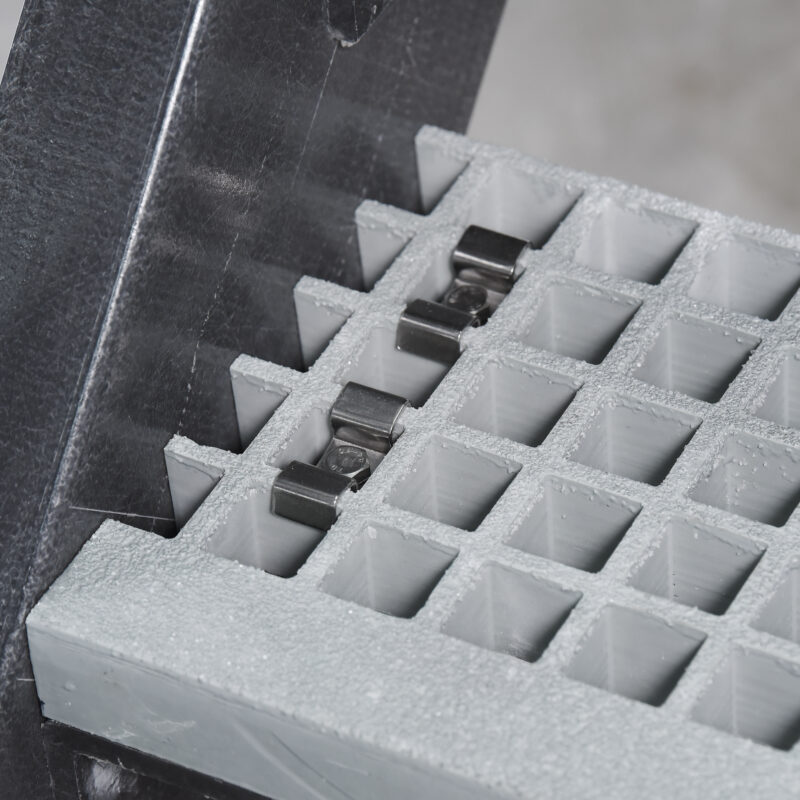


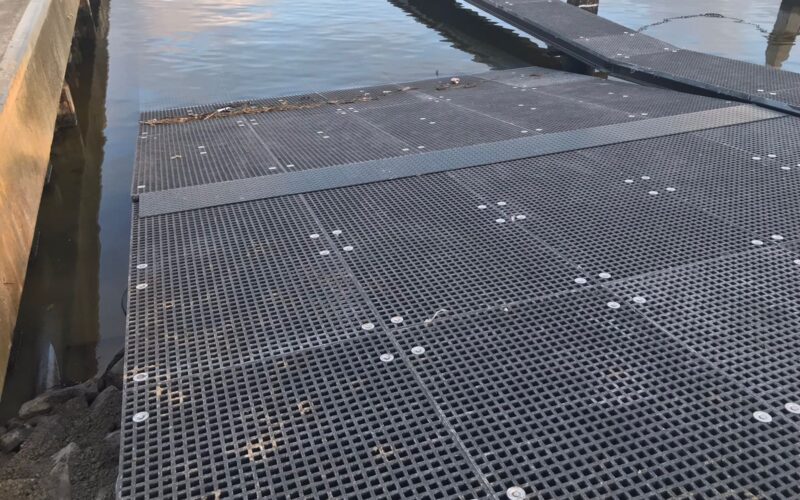
Plastic grille
ZR5-MG3V
Our GRP heavy-duty gratings (high load capacity) are designed for heavy loads and intensive use. They are corrosion-resistant, low-maintenance and suitable for demanding industrial applications.
- height
- 50mm
- Quality
- Vinylester
- Toplayer
- Quartz Grit
- color
- Zwart
- mesh-size
- 38 mm x 38 mm
| Article number | Height | Length | Width | Quotation |
|---|---|---|---|---|
| ZR4-3612-MG5V | 38 | 3660 | 1230 | Request a quotation |
| ZR4-CTS-MG5V | 38 | CUST | CUST | Request a quotation |
Frequently asked questions about this timetable
-
These HLC GRP gratings are designed for higher loads and larger spans than standard GRP gratings. They combine the well-known advantages of GRP (lightweight, corrosion-resistant and low-maintenance) with increased structural capacity.

HLC gratings are usually manufactured as moulded GRP gratings with:
- • higher loads to be absorbed,
- • greater grating height,
• heavier bar construction - • and/or a modified mesh structure.
⚙️ What makes HLC gratings different?
In HLC gratings, the construction (support bars) is optimised to:
• enable larger free spans,
• and limit deflection during intensive use.Like other moulded GRP gratings, HLC gratings bear loads in multiple directions.
With four-sided support, the shortest span can therefore often be used as the design span.Typical applications
GRP HLC gratings are used where standard gratings are not sufficient, for example in:
• industrial environments (often gutters) with heavier traffic,
• technical floors with point loads (machines, equipment),
• situations with large spans or limited support,🧩 Summary
HLC = High Load Capacity
Suitable for higher loads and larger spans
Lightweight, strong and corrosion-resistant alternative to steel👉 Would you like to know whether an HLC grating is required for your application, or whether a standard GRP grating is sufficient? We are happy to advise you based on load, span and use.
-
Traditional steel or stainless steel gratings consist of bearing bars and filler bars. The bearing bars determine the bearing direction: the grating bears in one main direction. Often referred to as:

With GRP gratings, this works differently, depending on the type of grating:
Moulded GRP gratings (the standard at FlexxCon): Our moulded GRP gratings are cast in one piece from fibreglass and resin. There are no separate bearing or filler bars; the grating forms a single cohesive structure in which all bars contribute to the strength.
This means:
- The grating bears load in four directions.
- There is no fixed bearing direction as with steel or stainless steel.
- With four-sided support, the shortest span can generally be used as the design span.
This multi-directional load-bearing capacity makes moulded GRP gratings strong, stable and flexible in application, even in complex support situations.
Pultruded GRP gratings (specific applications): In pultruded GRP gratings, the structure is made up of load-bearing and filler bars.
These behave in a similar way to steel gratings:- The load-bearing direction is parallel to the load-bearing bars.
- The strength is mainly directional, transferring to two sides.
- They are used where long spans or high stiffness in one direction are required.
👉 When designing or replacing gratings, it is important to know what type you have and how it is supported. We are happy to advise you on the right choice of grating, support and span.
-
Standard sizes (stock)
These are the panels we have in stock. The range of available panel sizes may vary depending on the type of grating. The availability of standard panels can be found under the relevant grating type on our website.
In addition to our standard commercial sizes, we can supply gratings that are made to measure for your specific application. We offer various options for customised GRP gratings, depending on your requirements, schedule and project size. There are various possibilities, but two are most common:
CTS (Cut to Size) – cut from stock panels
These GRP gratings are cut to size from our existing stock. We charge cutting costs and there is some material loss. We can easily calculate this.- Advantages: Fast delivery time, depending on the availability of the material (common grid types are usually in stock) and the current sawing schedule. Ideal for standard projects, smaller quantities or urgent projects.
CUST (Custom) – project-based production
These gratings are produced entirely to measure, with no or minimal material loss and often without or at lower processing costs.- Advantage: Cost-efficient for larger projects or repetitive dimensions.
- Disadvantage: Longer delivery time. In recent years, FlexxCon has built up such a strong position that there is always material in production, which means we can often switch quickly to ensure the shortest possible lead time. This is always custom work, and we are happy to help you personally.
In summary:
- CTS = fast delivery, ideal for standard and smaller or urgent orders.
- CUST = more efficient for larger quantities or fixed dimensions, but longer delivery time.