


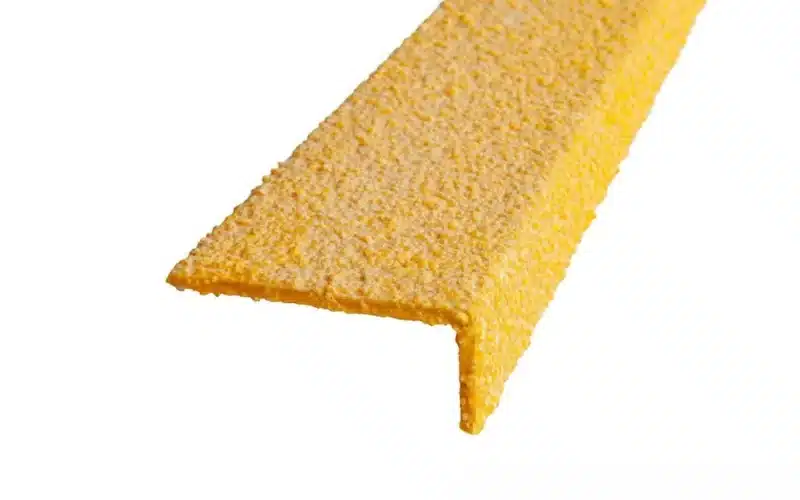
Anti slip stair nosing
T1-3700-QE
An anti slip stair nosing increases grip on a stair tread and improves the visibility of the edge of the staircase thanks to its highly visible yellow colour. The width is 70 mm and the height is 30 mm.
- Height
- 30mm
- Resin type
- Isophthalic polyester
- Toplayer
- Quartz Grit
- Color
- Yellow
| Article number | 30 mm | 3664 mm | 70 mm | CUST |
|---|---|---|---|---|
| T1-3700-QE | Hoogte | Lengte | Breedte | - |
| T1-CTS-QE | Hoogte | - | Breedte | Lengte |
Frequently asked questions about this GRP anti slip product
-
We often process requests on the same day or by the next working day at the latest.
We aim to provide standard GRP gratings and customised GRP gratings in small quantities (e.g. for a platform) within 1–2 working days.
For grating requests, a grating drawing (or simple sketch) helps us to provide a faster and more targeted quote.For project requests, we aim to provide a quote within one week. A grating layout, sketch or preliminary design significantly speeds up this process.
In addition, we sometimes need additional information, such as:- when you need the grating
- whether the dimensions and layout have already been determined
- and what the basic principles are (grating type, load, span protrusions)
Once these basic principles are clear, we can usually respond quickly.
GRP structures (such as platforms, ladders and handrails) usually require more coordination.
Once the basic principles are known (preferably supported by a sketch or design), we can often provide a quote within a week.If we still need to work out some details together, we will actively contact you and let you know when you can expect the quote.
-
GRP (glass fibre reinforced plastic) contains no metal and no organic material such as wood. This makes the material resistant to rust, rot and classic corrosion, even when exposed to moisture or outdoor conditions for long periods of time.
So what can happen?
Although GRP does not rust or rot, the material can be damaged if used incorrectly. This usually has to do with the choice of resin in relation to the environment.For example, using an unsuitable resin in a highly chemically stressed environment can cause the following phenomena:
- Chemical degradation of the resin,
- softening or discolouration of the surface,
- and in extreme cases, delamination (the separation of layers within the material).
These are not forms of rust or rot, but the result of a chemical incompatibility between the medium and the resin.
Important to know
- The glass fibres themselves remain strong; the damage is in the resin matrix.
- This type of damage does not usually occur suddenly, but gradually with prolonged exposure.
- With the right choice of resin (e.g. ISOFR, Vinylester or Phenolic), this can be easily prevented.
That is why we always recommend taking the application into account when choosing materials for chemical, industrial or ATEX environments.
👉 In summary:
GRP does not rust or rot, but it must be specified correctly. With the right resin, GRP is an extremely durable solution, even in harsh industrial environments. -
The lifespan of GRP depends on the application, environment and correct choice of material. Based on our experience, we estimate a lifespan of approximately 30 years for normal atmospheric conditions in Western Europe.
This does not mean that the material is ‘worn out’ after that. With correct application and favourable conditions, GRP can last longer in practice.
What determines whether GRP lasts longer?
Whether the lifespan exceeds the specified 30 years depends mainly on:
• the type of resin chosen (e.g. ISOFR, vinyl ester or phenolic),
• the degree of chemical or UV exposure,
• the mechanical load and deflection,
• and the quality of design, installation and use.When these factors are favourable, we see that GRP gratings and structures remain functional and safe after the specified service life.
When can the service life be shorter?
A shorter service life is usually caused by:
• the use of an unsuitable resin in an aggressive environment,
• prolonged exposure to media for which the material is not intended,
• or structural overload.
This can lead to surface ageing or, in rare cases, delamination, but not to rust or rot.Summary
Specified lifespan (Western Europe): approx. 30 years
Actual lifespan: longer, depending on application and environment👉 Would you like insight into the expected lifespan for a specific situation? We are happy to help you.